
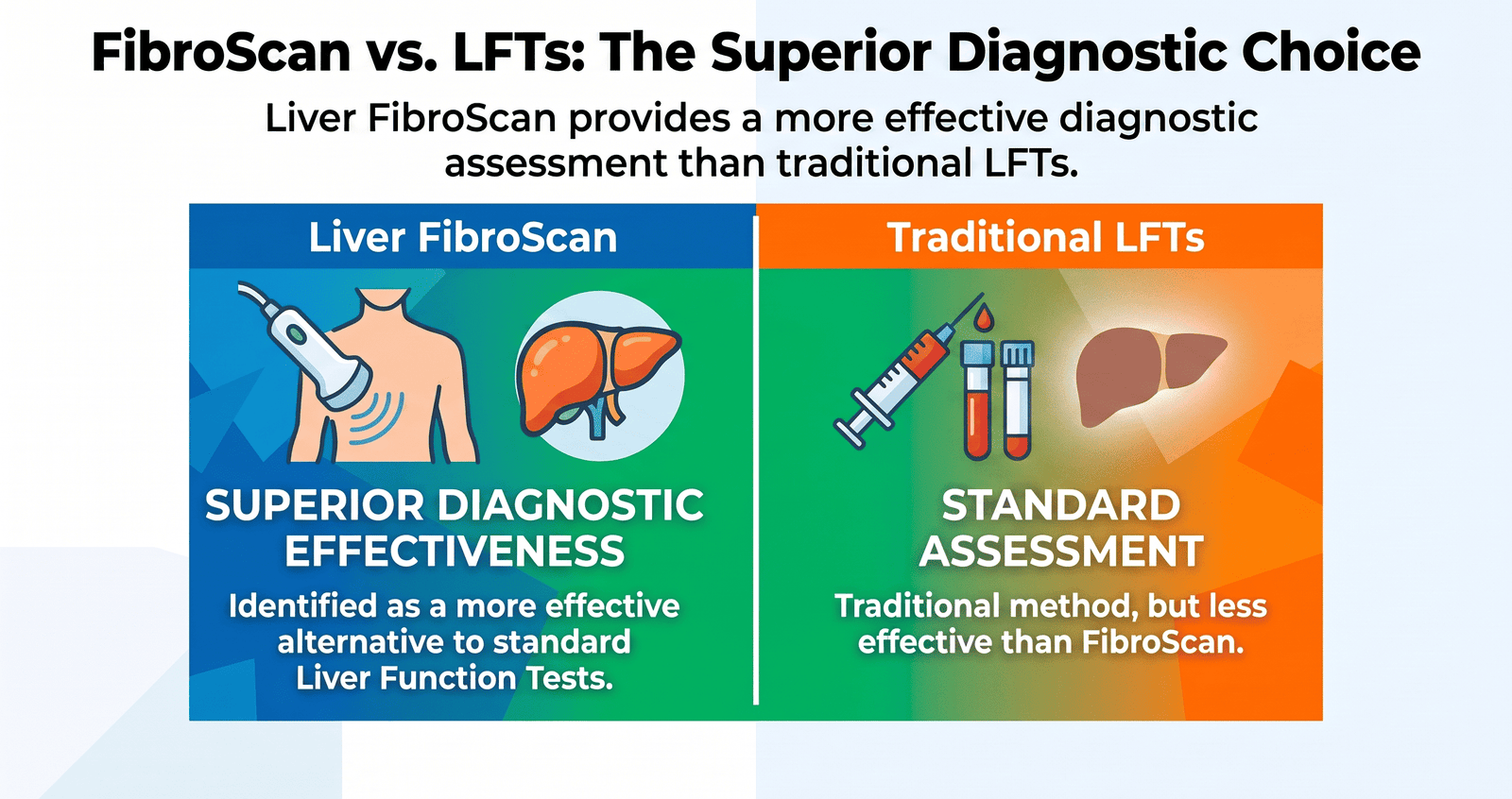
Why FibroScan Beats LFTs for Liver Assessment?
Have you, at some point in your life, come across the advice given by most people in Tamil Nadu to “get your liver function test done”? In fact, this test is performed frequently enough to make it one of the most requested blood tests in hospitals, clinics, and testing facilities across the state, whether state-run or private. Doctors request it almost always.
Patients accept it without question. And for decades, the Liver Function Test, or LFT, has been the standard way of checking whether the liver is doing its job properly.
But here is something that most patients are never told. An LFT can look completely normal even when your liver is seriously damaged inside. And that gap between what the blood test shows and what is actually happening inside the liver has cost many people in Tamil Nadu the one thing they needed most — early detection.
This is exactly where FibroScan changes everything.
What Is an LFT and What Does It Actually Tell You?
A Liver Function Test is a blood test that mainly measures the levels of enzymes and proteins such as AST, ALT, bilirubin, albumin, and others present in your blood. Damaged or dying liver cells cause these enzymes to spill over into the bloodstream, and the numbers go up. Doctors use this rising trend as an indication that there might be a problem with the liver.
The problem is this. The LFT only tells you that liver cells are currently being damaged or inflamed. It does not tell you how much scarring has already built up inside the liver over months and years. In fact, someone might have a very bad case of liver fibrosis, even stage F3, the most progressive one among them, and yet get a blood report showing that all liver-related biomarkers are within the normal range.
This is one of the most dangerous voids in routine liver care, particularly in Tamil Nadu, where conditions such as fatty liver disease, diabetes, and hepatitis B are all very common and often unnoticed. These diseases silently cause liver scarring without significantly raising enzyme levels in the initial stages.
So What Is FibroScan and Why Is It Different?
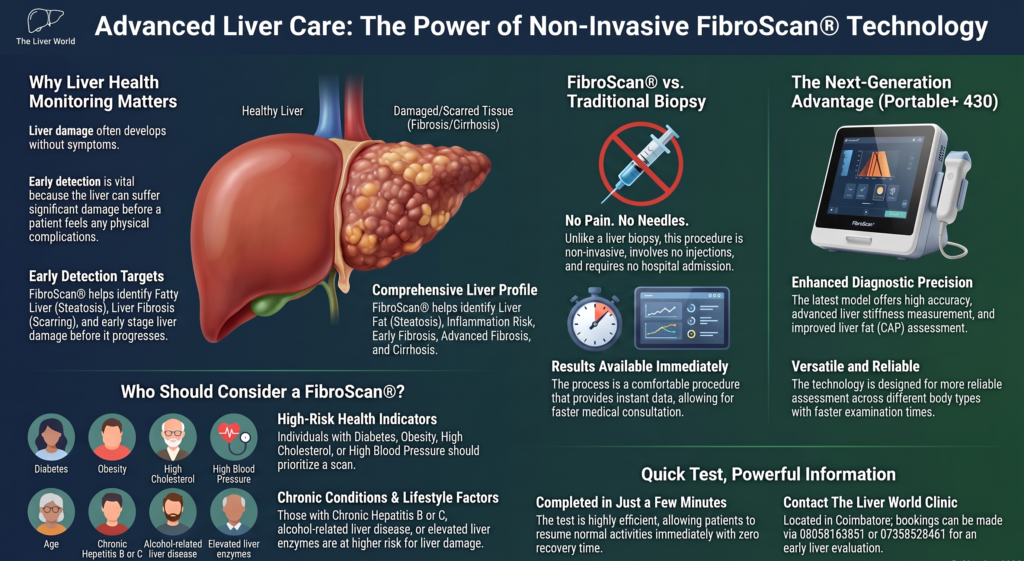
FibroScan is not a blood test. This scan is a specialized type of ultrasound that provides a direct measurement of the hardness of your liver. The concept is quite simple. Your healthy liver is usually soft and very pliable. However, when it is damaged or scarred over time, it becomes increasingly harder and more difficult to move. FibroScan works by passing a gentle sound wave through your liver and measuring how quickly the wave reaches its destination. Therefore, the more hardened your liver, the more rapidly the wave will travel and the higher your stiffness score will be.
This assessment of stiffness, measured in kilopascals (kPa), enables physicians to get an exact and trustworthy indication of the amount of fibrosis in the liver right this moment, not only if there is some inflammation present or enzyme leakage.
Moreover, FibroScan can measure liver fat simultaneously by a capability known as CAP (Controlled Attenuation Parameter). This means that if you just sit down and relax for ten minutes, the doctor can not only look at the amount of your liver fat without you experiencing the least bit of pain but also the level of scarring in the liver. No needle. No hospital admission. No recovery time needed.
The Key Differences Between LFT and FibroScan
The best approach to comprehend the distinction lies in drawing an analogy based on a situation all Tamil Nadu readers can relate to.
Let’s take the example of a liver as if it were a building. The LFT test is equivalent to a house check to see if there’s fire, at the moment, inside the building. If the smoke and fire alarm are active, you can safely say there is a problem. However, if the building caught fire in the past, the flame burned slowly, and the walls and foundation got so damaged that the alarm remains silent until the collapse is very near.
FibroScan is more comparable to the role of a building engineer who, after seeing that all cracks have disappeared, inspects the building structure, concrete slabs, and the foundations. It tells you the actual condition of the structure, regardless of whether there is a fire burning right now or not.
This is why FibroScan catches what LFTs miss. It does not wait for active damage signals. It literally measures the damage that gets silently added to the system over time!
Why does this issue hold greater significance in Tamil Nadu than most places?
Few states in India have as high a prevalence of Type 2 diabetes as Tamil Nadu. Research from Chennai has revealed that over 60 percent of adults examined were found to have fatty liver to some degree.
Till today, Hepatitis B has been a burden on the state, where the most affected people are adult populations who were born without a Hepatitis B vaccine that was already in widespread use.
For these three conditions, fatty liver, diabetic liver disease, and hepatitis B, the liver may go on producing substantial fibrous tissue for a long time before it raises the level of enzymes that LFT can detect.
Taking this into account, a simple blood test like LFT, which measures levels of certain chemicals in the blood that indicate liver function, will probably be quite misleading or incomplete as a result for a high percentage of Tamil Nadu adults. These are people who, in fact, run the risk of developing liver-related complications through these three conditions.
A normal LFT in these patients does not mean the liver is healthy. It means the liver is not currently inflamed. Confusing them is where the real danger lies since those two things differ a lot.
Who Should Consider Getting a FibroScan?
If you are a resident of Tamil Nadu and possess a number of these, a FibroScan is something you could chat about with your doctor.
Type 2 diabetes or pre-diabetes
Fatty liver confirmed on ultrasound
Being overweight, even without obvious symptoms
A history of hepatitis B or C
Regular alcohol consumption
Elevated liver enzymes that keep coming back on repeated LFTs
Liver disease or liver cancer in the family history
You have no reason to wait till you feel ill. Indeed, that’s exactly why liver disease gets to a point where its treatment becomes very challenging, as you wait for you to get feeling unwell.
Is FibroScan Available in Tamil Nadu?
Yes. FibroScan has been introduced in many hospitals and liver clinics in Tamil Nadu. Besides major cities such as Chennai, it is also available in Coimbatore, Madurai, Vellore, and Trichy. For instance, specialised liver clinics like The Liver World Clinic in Coimbatore have started offering this service specifically so that the patients in the region who were earlier relying on big metro hospitals could now get the service locally.
This method of examination takes about ten minutes, does not really require the patient to do much except fast for a few hours before it, and at the same time one gets the results straight away. Compare that to the weeks of distress that may be caused by an abnormal result from a Liver Function Test that does not even answer the questions you have!
Final Thought
The most important thing any person in Tamil Nadu can take away from this article is simple. A normal LFT does not guarantee a healthy liver. If you have risk factors for liver disease, and given the rates of diabetes and fatty liver in this state, a significant number of people reading this do, then getting a FibroScan is not an overreaction. It is the responsible next step.
Without complaining, doing everything possible, your liver is at your service from early morning till late at night. That is why a blood test, which reveals nothing more than a part of the puzzle, does not even come close to what your liver deserves.

Dr. Hemamala Ilango is a lead Hepatologist and Founder of The Liver World. She is a Liver specialist and Liver Transplant Physician, trained in Gastroenterology, Hepatology, Endoscopy, and Critical care. She treats critically ill and sick liver patients, especially cirrhotics, GI bleeding, and liver transplant patients.
Leave a Reply